Ever felt butterflies before a big presentation? Or an urgent bathroom trip right before a stressful meeting? That's not just in your head - it's in your gut. These reactions reveal a direct communication line between your brain and your digestive system that scientists call the gut-brain axis. And when stress becomes chronic, this connection can quietly derail your digestion every single day.
In short: why stress disrupts your digestion
When you're stressed, your brain activates the HPA axis and releases cortisol - a hormone that redirects blood flow away from your gut toward your muscles and brain. The result: bloating, slow digestion, diarrhoea or constipation.
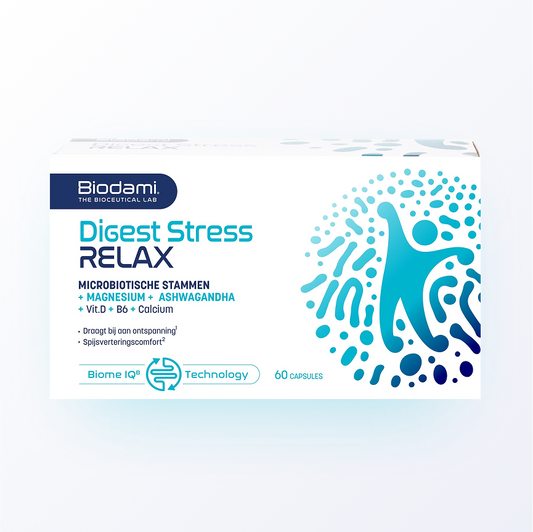
This connection runs both ways: a disrupted microbiome amplifies your stress response in return, creating a vicious cycle. The most effective supplements break this cycle on both sides simultaneously - psychobiotics to rebalance the microbiome, magnesium to support normal nervous system function, ashwagandha to support stress resistance. That's the mechanism behind Biodami's Digest Stress RELAX - the only Belgian formula specifically targeting the gut-brain axis.
Formulated in Belgium - biodami.com
Why does stress disrupt digestion?
The mechanism is precise and well-documented. When you perceive a threat or pressure, your body activates the sympathetic nervous system - the "fight or flight" mode - within seconds:
1
HPA axis activation The hypothalamus signals the pituitary gland, which activates the adrenal glands. Within minutes, cortisol and adrenaline flood your bloodstream.
2
Blood flow redirected away from the gut Cortisol pulls blood toward muscles and brain. Your intestines are left under-resourced - digestion becomes secondary to survival.
3
Transit speeds up or slows down Depending on your profile, gut motility either accelerates (diarrhoea) or slows (constipation). Both become problematic when repeated regularly.
4
Microbiome composition shifts Chronic cortisol alters your microbiome within 48 to 72 hours - reducing beneficial bacteria and favouring pro-inflammatory strains.
5
Feedback loop back to the brain A depleted microbiome sends negative signals via the vagus nerve, amplifying your stress response. The vicious cycle is now running.
What digestive symptoms are linked to stress?
The range of stress-related digestive issues is broader than most people realise:
Bloating
Slowed digestion leads to more bacterial fermentation. Gas accumulates more easily, especially after meals eaten quickly under pressure.
Diarrhoea or constipation
Adrenaline speeds up transit; chronic cortisol slows it down. IBS is frequently triggered or worsened by intense stress episodes.
Nausea and stomach cramps
Gastric acid production becomes erratic. Knotted-stomach sensations and heartburn are common during sustained stress periods.
Loss of appetite or cravings
Cortisol suppresses appetite short-term but drives sugar and fat cravings long-term - a classic stress-eating pattern.
Post-meal fatigue
When the gut is under-irrigated and the microbiome is off-balance, nutrient absorption suffers - amplifying afternoon energy crashes.
Increased food sensitivity
Stress increases intestinal permeability ("leaky gut"), which can trigger or worsen existing food intolerances and sensitivities.
The stress-digestion vicious cycle: how it takes hold
What makes this relationship so insidious is its bidirectional nature. The gut-brain axis creates a self-amplifying loop:
The loop that makes everything worse
- Chronic stress alters your microbiome composition within 72 hours
- A depleted microbiome produces less GABA and serotonin
- Less GABA means a poorly regulated nervous system - stress feels stronger
- More stress means more cortisol - microbiome disrupted further
- Result: digestive discomfort and anxiety mutually amplify each other
This is why approaches that treat only stress or only digestion deliver partial results. The solution needs to target both ends of the loop at the same time.
"You cannot treat stress while ignoring the microbiome, nor treat the microbiome while ignoring stress. They are two sides of the same system." - Prof. Emeran Mayer, UCLA
What ingredients should you look for in a stress-digestion supplement?
To act effectively on both fronts, a supplement needs several complementary active ingredients:
Gut-brain axis
Psychobiotics
L. rhamnosus, L. helveticus, L. plantarum and B. longum. Rebalance the microbiome and support GABA production - arriving alive in the gut is what counts, not just the strain count.
Nervous system
Magnesium bisglycinate
The EFSA recognises that magnesium contributes to normal nervous system function and the reduction of tiredness and fatigue. Bisglycinate is the best-absorbed form.
HPA axis
Ashwagandha KSM-66
Adaptogen studied for supporting stress resistance during periods of mental and nervous tension. KSM-66 is the most standardised and studied extract - 22 clinical trials on humans.
Neurotransmitter support
Vitamin B6
Essential cofactor for GABA and serotonin synthesis. The EFSA recognises that vitamin B6 contributes to normal nervous system function and the regulation of hormonal activity.
Our best match: Digest Stress RELAX
A Bioceutical Complex™ developed in Belgium by microbiome biologists. Combines 4 psychobiotic strains that colonise the gut and support the gut-brain axis, KSM-66 ashwagandha studied across 22 clinical trials, magnesium - whose contribution to normal nervous system function is EFSA-recognised - vitamin B6, calcium supporting normal digestive enzyme function, and vegan vitamin D.
- 4 psychobiotic strains
- Ashwagandha KSM-66
- Magnesium bisglycinate
- Vitamin B6
- Calcium
- Vegan vitamin D
View product
What can you do daily to reduce stress's impact on digestion?
While waiting for the full effect of supplements (3 to 8 weeks), these habits limit the immediate damage:
- Eat slowly and away from screens - the parasympathetic nervous system needs to be active for digestion to work properly
- Take a 10-minute walk after meals - it improves gut motility and helps bring cortisol down
- Drink water at room temperature, not cold - cold water slows digestive enzymes
- Avoid coffee on an empty stomach during high-stress periods - it amplifies morning cortisol release
- Add fermented foods to your diet (kefir, yogurt, kimchi) to support microbiome diversity
- Practice 5 minutes of box breathing or heart coherence before meals - it activates the vagus nerve and prepares the gut
Frequently asked questions: stress and digestive issues
Can stress really cause chronic digestive problems?
Yes. Repeated stress durably alters microbiome composition and gut motility. Research shows that prolonged stress is a major trigger of irritable bowel syndrome (IBS), which affects around 10% of the population - with the majority of cases having a functional rather than structural cause. Managing stress is therefore a core part of managing digestive health, not a separate issue.
Why do I get bloated when I'm stressed?
Cortisol reduces blood flow to the intestines and disrupts gut motility. Food ferments longer in the colon, producing more gas. On top of that, stress increases visceral sensitivity - meaning you feel normal levels of gas more acutely than usual. It's a double problem: more gas produced, and a heightened perception of it.
How do I know if my digestive issues are caused by stress or a food intolerance?
Timing is your first indicator. Stress-related symptoms tend to worsen during tense periods (Monday mornings, before presentations, during the let-down after a holiday) and improve at rest. Food intolerances follow meals regardless of emotional state. Keeping a food and mood diary for 3 weeks - logging both what you eat and your stress level - often reveals the pattern clearly.
What is the best supplement for stress AND digestion at the same time?
Supplements that genuinely address both require a coherent multi-ingredient formula - not just a single active. Biodami's Digest Stress RELAX combines specific psychobiotics (gut-brain axis), magnesium and vitamin B6 whose contribution to normal nervous system function is EFSA-recognised, and ashwagandha KSM-66 studied for stress resistance. The formula targets both ends of the stress-digestion loop. Available at biodami.com.
How long does a stress-digestion supplement take to work?
Magnesium can bring partial relief within the first week. Psychobiotics take 3 to 6 weeks to colonise the gut and shift the microbiome composition. Ashwagandha KSM-66 shows measurable effects on wellbeing between 4 and 8 weeks. For lasting improvement, plan for a minimum of 8 weeks of continuous use before assessing results.
Can stress cause chronic diarrhoea?
Yes - via sympathetic nervous system activation accelerating colonic transit. The mechanism behind pre-exam or pre-presentation diarrhoea is well established. When this becomes chronic, it can develop into diarrhoea-predominant IBS. Addressing it means targeting nervous system regulation and microbiome restoration simultaneously, not just managing the symptom.