

You watch what you eat. You cut back on sugar. You exercise. And yet you still feel that energy crash after meals, those inexplicable cravings mid-afternoon, that sense of your energy rising and falling without any clear reason.
What most nutrition guides won't tell you: your blood sugar doesn't depend solely on what you eat. It depends, deeply, on what lives in your gut.
What you'll understand after reading this article: the direct link between your gut microbiome and blood sugar regulation, the concrete biological mechanisms behind this connection, and how to support this natural system in a targeted way.
Your body already has the tools to regulate your blood sugar. Your microbiome is the central piece. It simply needs to be supported under the right conditions.
The Gut Microbiome: Far More Than a Digestive Organ
An Ecosystem of 38 Trillion Microorganisms
Your gut is home to approximately 38 trillion bacteria, roughly equal to the total number of cells in your body. These microorganisms form what we call the gut microbiome: a living, dynamic ecosystem that is unique to each individual.
For a long time, the microbiome was thought to serve primarily as a tool for digesting dietary fibre. Today, scientific research reveals a far more complex reality.
The microbiome is a metabolic organ in its own right. It communicates with your pancreas, liver, brain, and muscle cells. It produces active molecules that directly influence how your body manages glucose.
Your Gut: A Garden to Cultivate
Think of your microbiome as a garden. Some bacterial species are "useful plants": they produce protective molecules, regulate inflammation, and support your metabolism. Others are "weeds": they promote intestinal permeability and disrupt insulin signalling.
You don't force a garden to grow. You create the right conditions for it to thrive.
The same applies to your microbiome and your blood sugar. The goal isn't to "control" your glucose levels, but to support the intestinal ecosystem that regulates them naturally.
How Does the Microbiome Regulate Blood Sugar? The 3 Key Mechanisms
Mechanism 1: The Production of Short-Chain Fatty Acids (SCFAs)
When your gut bacteria ferment dietary fibre, they produce molecules called short-chain fatty acids (SCFAs): primarily butyrate, propionate, and acetate.
These SCFAs don't stay in the gut. They enter the bloodstream and act directly on your glucose metabolism:
-
Butyrate improves insulin sensitivity at the level of muscle cells
-
Propionate stimulates controlled hepatic glucose production, preventing hypoglycaemia
-
Acetate activates receptors (GPR43, GPR41) that regulate insulin release
In plain terms: the more diverse and rich your microbiome is in SCFA-producing bacteria, the more effectively your body manages glucose fluctuations after meals.
|
SCFA |
Main bacterial source |
Metabolic action |
|---|---|---|
|
Butyrate |
Faecalibacterium prausnitzii, Roseburia |
Insulin sensitivity, colonocyte energy |
|
Propionate |
Bacteroides, Akkermansia |
Regulation of hepatic gluconeogenesis |
|
Acetate |
Bifidobacterium, Lactobacillus |
GPR43 receptor activation, satiety |
A study published in Science in 2018 by Zhao et al. demonstrated that increased intake of fermentable fibre, by stimulating SCFA production, significantly improves glycaemic control in people with blood sugar imbalances.
Mechanism 2: The Natural Stimulation of GLP-1
GLP-1 (glucagon-like peptide-1) is an intestinal hormone you may have heard about recently, particularly through medications like Ozempic that mimic its action.
What few people know: your gut naturally produces GLP-1. And your microbiome plays a direct role in this production.
In January 2026, a study published in Nature Microbiology demonstrated that a common gut bacterium, Bacteroides vulgatus, stimulates GLP-1 secretion by the intestinal L-cells. The result observed in mice: better regulation of blood glucose levels and a reduction in sugar cravings.
What this means in practice: your microbiome is capable of triggering the same hormone that anti-obesity medications seek to imitate, but naturally, endogenously, and without side effects.
Natural GLP-1 produced by your gut:
-
Slows gastric emptying (you feel full for longer)
-
Stimulates insulin secretion in response to glucose
-
Reduces glucagon production (the hormone that raises blood sugar)
-
Decreases sugar cravings at the brain level
Mechanism 3: Protection of the Intestinal Barrier
An imbalanced microbiome (what we call dysbiosis) weakens the intestinal wall. This wall, normally impermeable, becomes leaky. Bacterial fragments called lipopolysaccharides (LPS) then pass into the bloodstream.
The result: chronic low-grade inflammation. And this inflammation is one of the most well-documented factors in insulin resistance.
The link is bidirectional and self-reinforcing:
-
Dysbiosis promotes inflammation, which promotes insulin resistance
-
Insulin resistance alters the composition of the microbiome, worsening dysbiosis
Supporting the diversity and integrity of your microbiome means breaking this cycle upstream.
Your Microbiome and Your Blood Sugar: A Personal Relationship
One of the most important discoveries of the past decade is that the glycaemic response to the same food varies considerably from person to person, and that this variability is largely explained by the microbiome.
Zeevi et al. (Cell, 2015) followed 800 people for a week using continuous glucose monitors. Their conclusion: glycaemic responses to foods are highly individual, and the gut microbiome is one of the best predictors of these differences.
It's not that some people "metabolise carbohydrates better." It's that their microbiome creates an intestinal environment that attenuates post-meal glucose spikes.
What this means: two people can eat the exact same meal and have radically different glycaemic responses. The difference doesn't come from willpower. It comes from the gut.
Dysbiosis and Blood Sugar Imbalance: When the Microbiome Struggles
A depleted or imbalanced microbiome produces fewer SCFAs, stimulates less endogenous GLP-1, and provides weaker protection of the intestinal barrier. These three deficits compound to undermine glycaemic regulation.
Signs That Your Microbiome Needs Support
Certain signs may indicate that your gut microbiome is going through a difficult period:
-
Marked fatigue after carbohydrate-rich meals
-
Recurring sugar cravings, especially mid-afternoon
-
Frequent bloating and digestive discomfort
-
Significant energy fluctuations throughout the day
-
Difficulty maintaining a stable weight despite a balanced diet
These signals are not diagnostic certainties. But they often indicate that the gut-metabolism axis deserves closer attention.
What Weakens the Microbiome
Several modern factors deplete gut bacterial diversity:
-
Ultra-processed foods: low in fibre, high in additives that disrupt the microbial ecosystem
-
Antibiotics: necessary in some cases, but they drastically reduce bacterial diversity
-
Chronic stress: the gut-brain axis is bidirectional; stress alters microbiome composition
-
Sleep deprivation: disrupts the circadian rhythm of the microbiome, which also has its own "biological clock"
-
Sedentary lifestyle: physical activity is one of the most powerful stimulants of microbial diversity
How to Support Your Microbiome for Better Blood Sugar Regulation
Food as the Primary Lever
Your microbiome feeds on what you eat. More precisely, it ferments the fibres that your digestive enzymes cannot break down.
The most effective fermentable fibres for stimulating SCFA production:
-
Inulin and fructo-oligosaccharides (FOS): leeks, onions, garlic, Jerusalem artichoke, chicory
-
Beta-glucans: oats, barley, certain mushrooms
-
Resistant starch: cooled potatoes, cooled rice, green bananas
-
Pectins: apples, citrus fruits, carrots
The order in which you eat foods also matters. Starting with vegetables and proteins before carbohydrates reduces post-meal glucose spikes by 20 to 30% according to several clinical studies.
Targeted Probiotics: Supporting the Right Species
Not all probiotics are equal. To specifically support glycaemic regulation, certain strains have been the subject of clinical studies:
-
Lactobacillus acidophilus: improves insulin sensitivity
-
Bifidobacterium longum: reduces intestinal inflammation and supports SCFA production
-
Akkermansia muciniphila: strengthens the intestinal barrier and improves glucose tolerance
-
Lactobacillus rhamnosus: supports appetite regulation via GLP-1
Clinical research confirms the value of combining probiotics with other metabolic actives. A study published in Le Quotidien du Médecin in June 2025 showed that the combination of probiotics and a GLP-1 agonist reduced HbA1c by -1.06% compared to only -0.35% with the medication alone, demonstrating the power of the combined approach.
Complementary Actives: Acting on Multiple Levels
The microbiome is the central regulator, but it can be supported by actives that work downstream:
-
Reducose® (a patented white mulberry extract) slows carbohydrate absorption at the intestinal level, reducing the amplitude of glucose spikes before they even place demands on the microbiome
-
Chromium contributes to the maintenance of normal blood glucose levels by supporting insulin signalling at the cellular level (officially authorised EFSA health claim)
The most effective approach is not to choose between microbiome support, absorption inhibition, and insulin signalling support. It's to combine them in a coherent formulation.
What the Science Concludes: The Microbiome at the Heart of Blood Sugar Regulation
Research over the past decade has profoundly changed our understanding of glucose metabolism. The gut microbiome is no longer a secondary player in digestion: it is a first-order metabolic regulator, whose influence on blood sugar is today solidly documented.
Three essential points to remember:
-
The microbiome produces molecules (SCFAs) that directly improve insulin sensitivity and attenuate post-meal glucose spikes.
-
Gut bacteria naturally stimulate GLP-1, the hormone that anti-obesity medications seek to imitate.
-
Dysbiosis is an aggravating factor in insulin resistance: caring for your microbiome means acting upstream on the entire glucose metabolism.
Your body doesn't need to be forced. It needs to be supported. And that distinction changes everything about the approach.
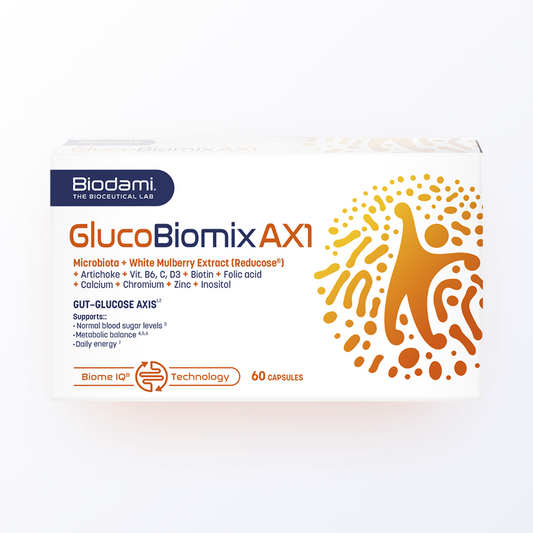
GlucoBioMix AX1: A Formula Designed to Support This Natural Mechanism
At Biodami, we formulated GlucoBiomix AX1 around this understanding of glucose metabolism.
The formula combines three complementary levels of action:
-
Specifically selected probiotic strains for their role in SCFA production and endogenous GLP-1 stimulation
-
Reducose® (patented white mulberry extract, 50x more concentrated in DNJ than standard extracts), clinically validated to reduce postprandial blood glucose by more than 40% (Thondre et al., Nutrition & Metabolism, 2021)
-
Chromium, whose EFSA health claim confirms its role in maintaining normal blood glucose levels
This is not a single-active approach. It is a formula that works from the gut to the cell, respecting your body's natural mechanisms.
We are not trying to force your metabolism to change. We are working to support it in a way that respects how it naturally functions.