Ozempic. Wegovy. Mounjaro. These names have dominated health conversations for the past two years. Millions of people are now injecting synthetic GLP-1 to manage their blood sugar and appetite.
But here's what the headlines are missing: your gut already produces GLP-1 naturally. And a landmark study published in January 2026 shows that specific gut bacteria are directly responsible for triggering it.
The short answer: No, your microbiome cannot replace a GLP-1 medication. But it can stimulate the same hormone naturally, without a prescription, without side effects, and without the expensive monthly treatment cost. Here's what the science actually says.
This isn't an anti-medication argument. It's a case for understanding what your body is already designed to do, and how to support it better.
What Is GLP-1 and Why Is Everyone Talking About It?
The Hormone Behind the Ozempic Effect
GLP-1 (glucagon-like peptide-1) is a hormone produced in your intestine in response to food. Its job is to coordinate your body's response to glucose after a meal.
When GLP-1 is released, it does four things simultaneously:
-
Slows gastric emptying so glucose enters the bloodstream more gradually
-
Stimulates insulin secretion precisely when blood sugar rises
-
Suppresses glucagon (the hormone that tells your liver to release more glucose)
-
Signals satiety to the brain, reducing appetite and sugar cravings
Drugs like semaglutide (Ozempic, Wegovy) work by mimicking this hormone with a synthetic version that lasts far longer in the body than natural GLP-1. The results in clinical trials have been striking: significant blood sugar improvements and substantial weight loss in many patients.
The Problem With the Medication Narrative
The explosion of GLP-1 medications has created a misleading impression: that GLP-1 is something you need to inject because your body doesn't make enough of it.
That's not quite right.
Your intestinal L-cells produce GLP-1 every time you eat. The question isn't whether you produce it. The question is how much, how efficiently, and what factors influence that production. And that's where your microbiome enters the picture.
Your Microbiome as a Natural GLP-1 Factory
The January 2026 Discovery That Changes the Conversation
In January 2026, researchers published a study in Nature Microbiology that deserves far more attention than it received outside scientific circles.
The finding: a common gut bacterium called Bacteroides vulgatus directly stimulates GLP-1 secretion by intestinal L-cells. In mice with increased levels of this bacterium, natural GLP-1 production rose significantly. The result: better blood glucose regulation and a measurable reduction in sugar cravings.
Why this matters: Bacteroides vulgatus is not a rare or exotic microorganism. It's one of the most prevalent bacteria in the human gut. The implication is that the GLP-1 pathway is already active in your intestine, and that its efficiency depends in part on the composition of your microbiome.
The SCFA Pathway: A Second Route to Natural GLP-1
Bacteroides vulgatus is not the only mechanism. Short-chain fatty acids (SCFAs), produced when gut bacteria ferment dietary fibre, also stimulate GLP-1 secretion through a separate pathway.
SCFAs bind to receptors on intestinal L-cells:
|
Receptor |
SCFA trigger |
Effect on GLP-1 |
|---|---|---|
|
GPR43 |
Acetate, propionate |
Stimulates GLP-1 release |
|
GPR41 |
Propionate, butyrate |
Enhances L-cell sensitivity |
|
TGR5 |
Secondary bile acids (microbiome-modulated) |
Amplifies GLP-1 secretion |
The key producers of these SCFAs are bacteria like Bifidobacterium, Lactobacillus, Faecalibacterium prausnitzii, and Akkermansia muciniphila. When these species thrive, your natural GLP-1 production is better supported.
In practical terms: a diverse, fibre-fed microbiome doesn't just help digestion. It actively maintains the hormonal system your body uses to regulate blood sugar after every meal.
Natural GLP-1 vs. Medication: An Honest Comparison
This is the question most people are actually asking, so it deserves a direct, honest answer.
|
|
Natural GLP-1 (microbiome-supported) |
GLP-1 medication (semaglutide) |
|---|---|---|
|
Source |
Produced by your own intestinal L-cells |
Synthetic analogue, injected weekly |
|
Duration of action |
Minutes (rapidly degraded by DPP-4) |
Days (engineered to resist degradation) |
|
Magnitude of effect |
Moderate, physiological |
Pharmacological (much higher blood levels) |
|
Side effects |
None |
Nausea, vomiting, GI discomfort (common) |
|
Cost |
Cost of diet and supplements |
€200-400/month, ongoing |
|
Requires prescription |
No |
Yes |
|
Suitable for |
Metabolic support, prevention, lifestyle optimisation |
Clinical management of type 2 diabetes, obesity |
The honest conclusion: these are not the same thing. GLP-1 medications produce effects that diet and supplements cannot replicate in people with significant metabolic dysfunction. If your doctor has prescribed semaglutide, this article is not a reason to stop.
But for the large majority of people who are not on GLP-1 medications and are simply trying to regulate their blood sugar more naturally, the microbiome pathway is real, clinically supported, and worth taking seriously.
What Disrupts Your Natural GLP-1 Production?
Dysbiosis: The Hidden Brake on GLP-1
When the gut microbiome is imbalanced (dysbiosis), SCFA-producing bacteria decline. Fewer SCFAs means less stimulation of GPR43 and GPR41 receptors on L-cells. Natural GLP-1 output drops.
At the same time, dysbiosis increases intestinal permeability. Bacterial fragments (LPS) enter the bloodstream, triggering chronic low-grade inflammation. This inflammation has been shown to reduce the sensitivity of GLP-1 receptors in target tissues, meaning even the GLP-1 that is produced becomes less effective.
The result is a double hit: less GLP-1 produced, and less response to the GLP-1 that is produced.
The Foods That Undermine GLP-1 Signalling
Certain dietary patterns actively suppress the microbiome's ability to support GLP-1:
-
Low-fibre diets starve SCFA-producing bacteria, reducing the fermentation that drives GLP-1 secretion
-
High-sugar diets favour Proteobacteria over Bacteroides and Bifidobacterium, shifting the microbiome away from GLP-1-supporting species
-
Emulsifiers and artificial sweeteners (common in ultra-processed foods) have been shown in multiple studies to disrupt gut barrier integrity and alter microbiome composition
How to Naturally Support Your GLP-1 System
Step 1: Feed the Right Bacteria
The bacteria most associated with GLP-1 stimulation need fermentable fibre to thrive. Specifically:
-
Inulin and FOS (chicory, Jerusalem artichoke, onions, garlic): preferentially feed Bifidobacterium species
-
Beta-glucans (oats, barley): increase Akkermansia muciniphila and butyrate producers
-
Resistant starch (cooled potatoes, green bananas): strongly stimulates Faecalibacterium prausnitzii
-
Polyphenols (berries, dark chocolate, green tea): support Bacteroides diversity, including B. vulgatus
Aim for 30+ different plant foods per week. Diversity of fibre sources drives diversity of bacterial species, which is the single best predictor of robust SCFA and GLP-1 production.
Step 2: Introduce the Right Probiotic Strains
Not all probiotics support GLP-1. The strains with the strongest evidence for metabolic and glycaemic support include:
-
Lactobacillus rhamnosus: shown to enhance GLP-1 secretion and reduce appetite signalling
-
Bifidobacterium longum: supports SCFA production and reduces the intestinal inflammation that blunts GLP-1 receptor sensitivity
-
Akkermansia muciniphila: strengthens the gut barrier and has been directly associated with improved GLP-1 response in multiple studies
-
Lactobacillus acidophilus: improves insulin sensitivity downstream of GLP-1 signalling
A clinical trial published in Le Quotidien du Médecin in June 2025 demonstrated that combining probiotics with a GLP-1 agonist reduced HbA1c by -1.06% versus -0.35% with the drug alone. The microbiome, in other words, amplifies the GLP-1 signal, whether that signal is natural or pharmacological.
Step 3: Reduce What Suppresses GLP-1
Practical changes that protect your natural GLP-1 system:
-
Eat vegetables and protein before carbohydrates at each meal: this slows gastric emptying and extends natural GLP-1 release over a longer window
-
Manage chronic stress: cortisol directly suppresses GLP-1 secretion and alters microbiome composition
-
Prioritise sleep: a single night of poor sleep measurably reduces GLP-1 response to breakfast the following morning
-
Limit ultra-processed foods: even short-term consumption of highly processed diets has been shown to reduce microbial diversity within days
Step 4: Support Glucose Absorption Directly
Even with a well-supported microbiome, post-meal glucose spikes can still occur, particularly after high-carbohydrate meals. This is where complementary actives become relevant.
Reducose®(patented white mulberry extract) works at the intestinal level as an alpha-glucosidase inhibitor. It slows the breakdown of complex carbohydrates into glucose, reducing the amplitude of the post-meal spike before it even reaches the bloodstream. In a randomised, double-blind, placebo-controlled trial (Thondre et al., Nutrition & Metabolism, 2021), 250mg of Reducose reduced peak postprandial blood glucose by 40% and peak insulin by 40-49% over 120 minutes.
Chromium supports insulin signalling at the cellular level. Its role in contributing to the maintenance of normal blood glucose levels is an officially authorised EFSA health claim.
The Bigger Picture: A System, Not a Single Hormone
The GLP-1 conversation has been dominated by pharmaceutical companies with a product to sell. The narrative is simple: your body doesn't produce enough GLP-1, so here's a drug that compensates.
The reality is more nuanced, and more empowering.
Your gut is already a GLP-1 production system. Bacteroides vulgatus, Bifidobacterium, Akkermansia, and dozens of other species are working every day to support the hormonal regulation of your blood sugar. What determines how well they do their job is largely within your control: what you eat, how you sleep, how you manage stress, and whether you give your microbiome the specific support it needs.
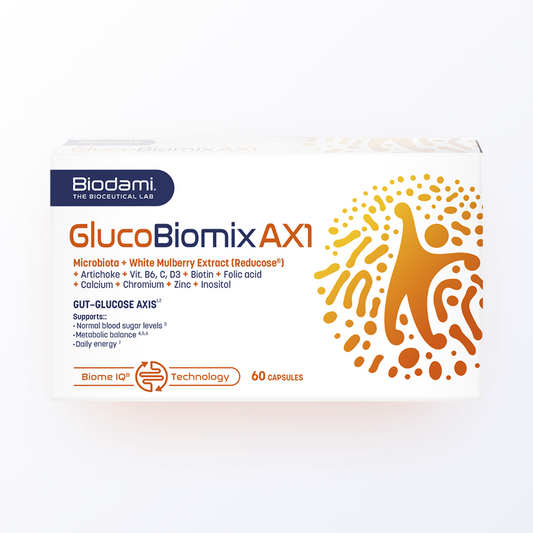
GlucoBiomix AX1 was formulated around this understanding. The probiotic strains were selected for their documented role in SCFA production and GLP-1 pathway support. Reducose addresses the absorption side of the equation. Chromium supports the downstream insulin signalling.
It is not a medication. It does not replace one. But for anyone looking to support their body's natural glucose regulation system, it addresses the mechanism at the right level.
Your microbiome was regulating your blood sugar long before Ozempic existed. It just needs the right conditions to do it well.